
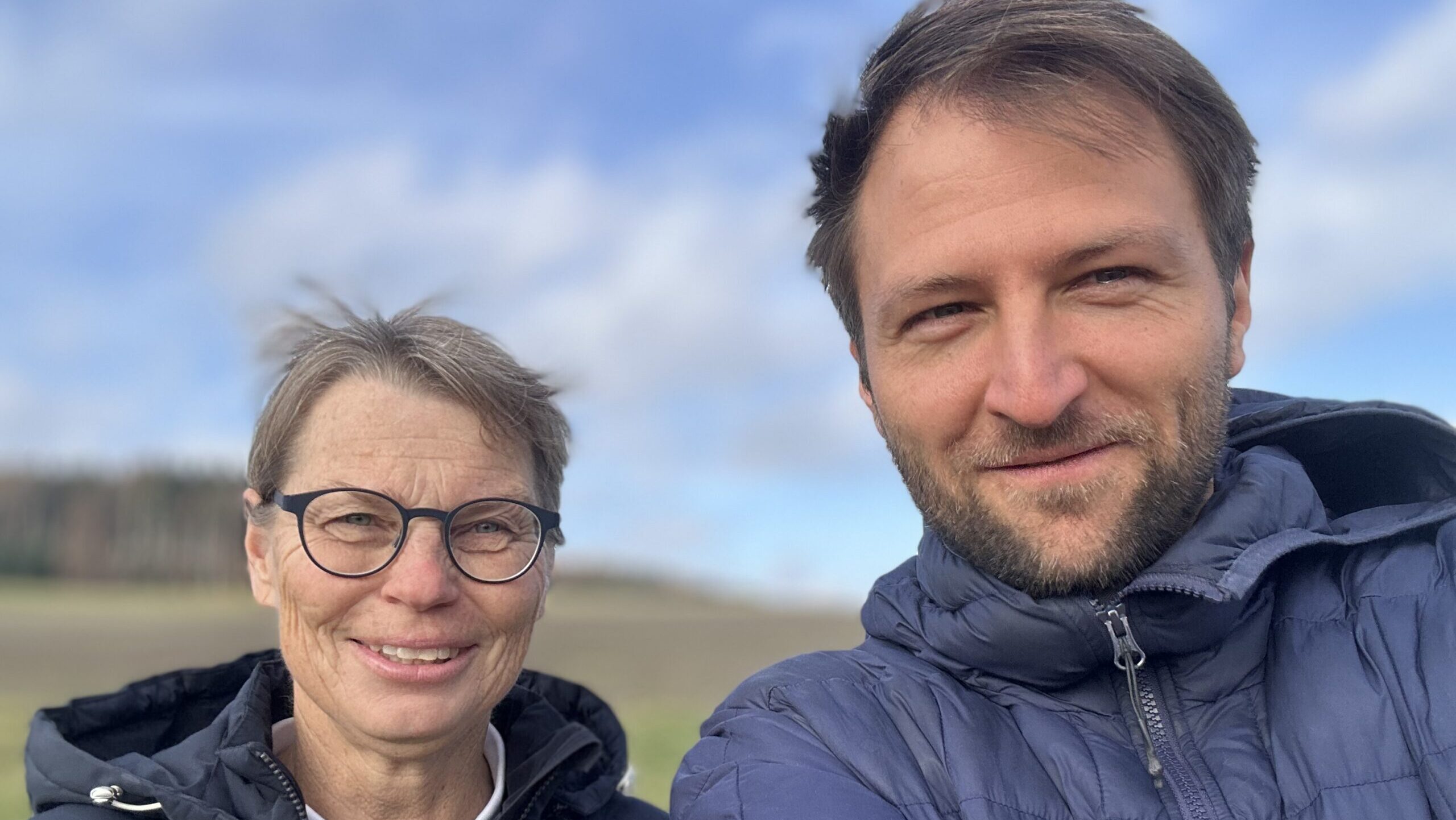
Farmer and landowner Ingrid Heidemann shares first-hand insights into her experience working with Ampermo.
Project Highlights
Location: Erisweiler
Project: 20 MWp photovoltaic plant plus 60 MWh green and grey energy storage
Development period: June 2023 to November 2024
Short Interview
Ingrid Heidemann is a farmer and entrepreneur. After completing her studies in agricultural sciences, she took over her family’s farm and gradually expanded it together with her husband. Over the years, forestry and a local district heating supply were added to the business. In time, the idea of making land available for renewable energy projects also emerged. In a conversation with our Managing Director, Maximilian Heilgemair, Mrs Heidemann explains how an initial idea—accompanied by early reservations—developed into a flagship project, and why she found the right partner in Ampermo for this journey.
Mrs Heidemann, what led you to consider making your land available for renewable energy projects?
The initial trigger was actually several inquiries from project developers. At first, I gave a lot of thought to whether it made sense to take arable land out of agricultural production for energy generation. At the same time, as a farmer, I strongly believe in the principle of closed-loop systems—making use of what is available locally. Events such as the Fukushima disaster and the COVID-19 pandemic made it very clear to me that independence through decentralized energy supply makes our society more resilient.
Giving up arable land is a major decision. What ultimately convinced you to take this step?
I realized that the energy transition primarily takes place in rural areas and that farmers can play an active role in shaping it. At the same time, such a project offers the opportunity to benefit economically and to a certain extent reduce dependence on the volatility of agricultural yields, which are influenced by factors such as weather conditions, regulation, or pests. Once the operating phase ends, the land can be returned to agricultural use. In addition, I believe it makes sense to give intensively farmed land a longer period of rest, so that it remains productive for future generations.
Given the large number of inquiries, why did you ultimately decide to work with Ampermo?
The contact with Ampermo came through a recommendation from my personal network. From the very beginning, I was impressed by the cooperative, partnership-based approach at eye level. The offer was economically attractive while also being clearly and transparently structured. At all times, I felt that I was being treated fairly. I also greatly appreciated the support in developing a suitable structure for the future transfer of the farm to my children.
How did you experience the project development process?
Communication with Ampermo was excellent throughout the entire process. I always felt well informed and could get in touch at any time. In addition to their technical expertise, I particularly valued the constructive and solution-oriented collaboration. Challenges—such as securing cable routes or identifying suitable compensation areas—were addressed jointly and resolved efficiently. Overall, the project development ran very smoothly and in a way that generated no negative feedback from the local community. Throughout the process, I had the feeling that this was not just an Ampermo project, but a truly joint endeavor.
Looking back today: Would you implement the project again? And what advice would you give to other landowners?
Yes, absolutely. I can wholeheartedly recommend Ampermo as a partner to other landowners and farmers. In general, I would advise anyone—even when conditions appear attractive—to take sufficient time to fully understand contracts and carefully consider their potential implications. This includes aspects such as farm succession, the conversion of arable land, and dynamics within the local community. For all of these topics, we were able to find sound and sustainable solutions together with Ampermo.
Thank you very much, Mrs Heidemann, for the open conversation and the excellent collaboration. We hope this interview demonstrates how the energy transition and agriculture can successfully go hand in hand.